- [email protected]
- 00974-50540047

Manufacturing is entering one of the most transformative periods in its history.
The convergence of artificial intelligence, automation, sustainability mandates, supply chain restructuring, and workforce shifts is reshaping how products are designed, produced, and delivered. While these trends create enormous opportunities, they also introduce significant challenges that manufacturers must navigate to remain competitive.
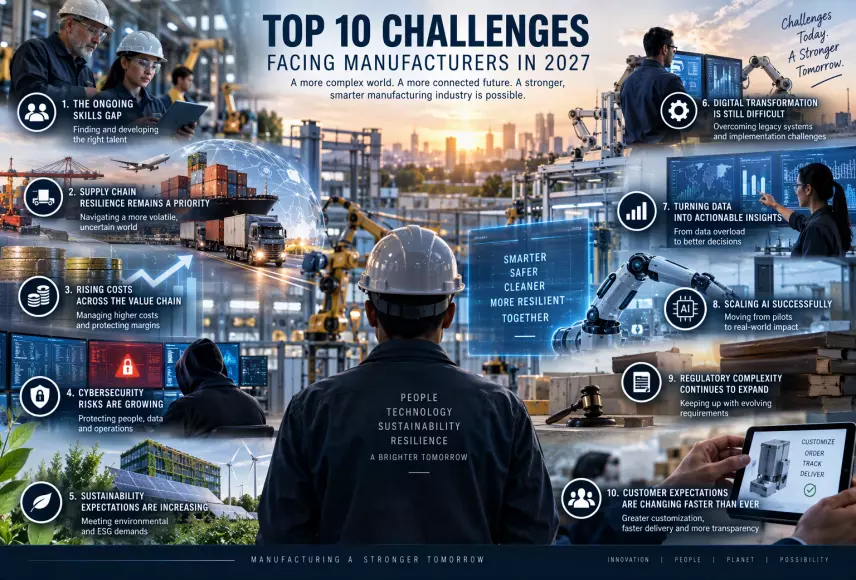
As we look toward 2027, here are the ten most pressing issues manufacturing leaders should prepare for.
Technology is advancing faster than the available workforce can adapt.
Manufacturers are increasingly seeking employees skilled in automation, robotics, AI, digital analytics, and advanced maintenance. At the same time, many experienced workers are reaching retirement age, taking decades of operational knowledge with them.
Leadership Focus: Invest in upskilling programs, apprenticeship initiatives, and partnerships with technical institutions to build future-ready talent pipelines.
The lessons learned from global disruptions over the past several years continue to shape manufacturing strategies.
Companies can no longer assume stable access to materials, components, and transportation networks. Resilience has become just as important as efficiency.
Leadership Focus: Diversify suppliers, strengthen local sourcing options, and deploy technologies that improve real-time supply chain visibility.
Manufacturers are facing continued pressure from labor expenses, raw material costs, energy prices, and transportation fees.
Margin protection is becoming increasingly difficult in highly competitive markets.
Leadership Focus: Use automation, predictive maintenance, and operational excellence initiatives to improve productivity and reduce waste.
As factories become more connected, cyber threats move from the IT department directly onto the production floor.
Connected devices, industrial control systems, and digital supply chain platforms create new vulnerabilities that attackers can target.
Leadership Focus: Treat cybersecurity as a business risk, not just a technology issue. Strengthen both IT and operational technology security frameworks.
Environmental, Social, and Governance (ESG) performance is no longer optional.
Customers, investors, regulators, and employees increasingly expect manufacturers to demonstrate measurable progress in reducing environmental impact.
Leadership Focus: Embed sustainability into business strategy through energy efficiency, emissions reduction, waste minimization, and sustainable sourcing initiatives.
Despite widespread investment in Industry 4.0 technologies, many organizations struggle to achieve expected results.
Legacy systems, fragmented data, and change management challenges often slow transformation efforts.
Leadership Focus: Prioritize initiatives that deliver measurable business outcomes rather than pursuing technology for its own sake.
Manufacturers generate massive amounts of data every day.
The challenge is no longer collecting information. The challenge is extracting meaningful insights that drive better decisions.
Leadership Focus: Establish strong data governance practices and leverage advanced analytics and AI to improve operational decision-making.
Artificial intelligence has moved beyond experimentation and into operational deployment.
However, manufacturers still face challenges around implementation costs, data quality, workforce adoption, and governance.
Leadership Focus: Start with high-value use cases such as predictive maintenance, quality control, forecasting, and process optimization before scaling broadly.
Manufacturers must comply with evolving regulations related to environmental impact, product traceability, worker safety, trade requirements, and data privacy.
Keeping up with changing compliance obligations is becoming increasingly resource-intensive.
Leadership Focus: Build compliance management into core business processes rather than treating it as a standalone function.
Customers expect higher levels of customization, faster delivery times, greater transparency, and consistent product quality.
The companies that can deliver flexibility without sacrificing efficiency will gain a significant competitive advantage.
Leadership Focus: Develop agile manufacturing capabilities and strengthen customer-centric operations.
The manufacturers that thrive in 2027 will not necessarily be the largest or the most established.
They will be the organizations that adapt the fastest.
Success will depend on balancing innovation with resilience, embracing technology while investing in people, and pursuing operational excellence alongside sustainability goals.
The future of manufacturing is not just about producing more. It's about producing smarter, faster, cleaner, and with greater agility than ever before.
Which of these challenges do you believe will have the biggest impact on manufacturing over the next three years? Share your perspective in the comments.

AddiSol Engineering is now the official distributor of AM PravaH in the Middle East, including Saudi Arabia, UAE, Qatar, and more. Empowering additive manufactu...