- [email protected]
- 00974-50540047

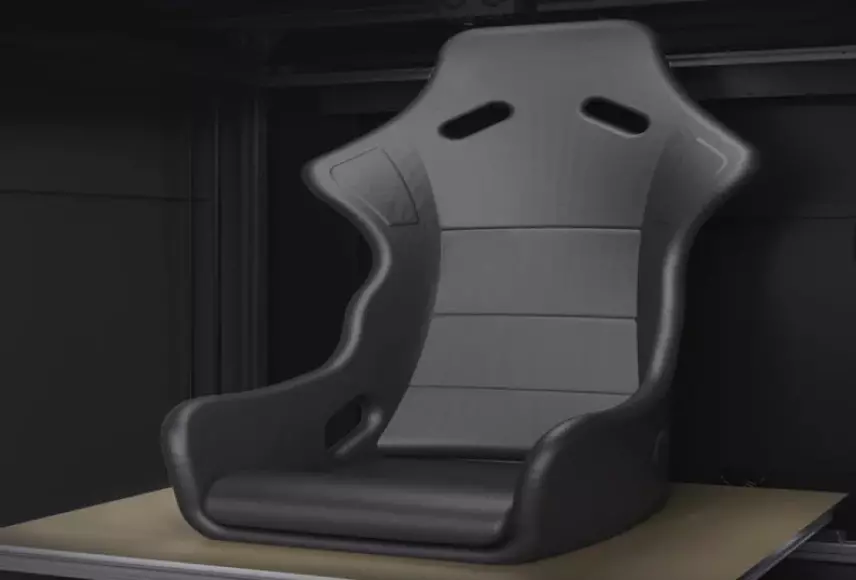
A full-scale prototype that cannot fit on a standard printer. A custom fixture needed for a new assembly process. A large mold that would otherwise require extensive machining.
These are the kinds of applications where large-format 3D printing deserves consideration. Its value is not simply the ability to make bigger objects. It is the opportunity to rethink how certain parts, tools, and prototypes are produced.
But a larger printer does not automatically mean a better manufacturing solution. The business case depends on the application, material requirements, finishing work, and total production cost.
Large-format 3D printing extends additive manufacturing to components beyond the capacity of smaller systems. For polymer applications, this includes filament-fed extrusion and pellet-fed extrusion, with different balances of deposition rate, detail, and finishing requirements. Not all large-format systems offer the same capabilities.
The first question should therefore be“What does the application require?”, not simply“How large is the build volume?”
A full-scale model allows teams to assess a design at its intended size. For an equipment housing, vehicle panel, or product enclosure, that can help structure discussions around fit, access, assembly, and appearance.
Consider a team developing a new machine enclosure. A full-size prototype could be used to check whether maintenance panels are accessible and whether neighboring components interfere before committing to production tooling.
The prototype does not necessarily need the material properties of the final product. It needs to answer the right design questions.
Large-format printing also has applications in tooling, including trim tools and fixtures. These applications can be particularly relevant when a tool is customized to a specific component or process.
Potential candidates include positioning fixtures, assembly supports, and checking tools. Each should be assessed against its actual loads, required accuracy, operating environment, and expected service life.
The opportunity is not to replace every metal fixture with plastic. It is to identify where a printed solution can meet the requirements with a more suitable production workflow.
Molds and composite tooling are established areas of large-format polymer additive-manufacturing research and application. Examples include lay-up tools, casting dies, and molds for different composite-processing methods.
However, printed does not always mean ready to use. A tool may require machining, sealing, coating, or other finishing operations before it meets dimensional and surface requirements. Those steps belong in the original production plan, not as an afterthought.
A larger build envelope creates the option to print a component in one piece, but that should be a design decision rather than an automatic preference.
Ask:
The best solution may be a single print, a segmented assembly, or a hybrid design combining printed components with conventional materials.
Large polymer prints bring challenges beyond build volume. Cooling behavior, thermal distortion, layer bonding, and direction-dependent properties can affect the final result. Fiber-reinforced materials can improve certain properties, but they do not remove the need for process control and application-specific validation.
Before selecting a process, define:
A successful demonstration print is a useful starting point. A dependable production solution requires evidence that the finished part consistently meets its intended requirements.
A meaningful comparison should include more than material consumption and machine time.
Consider design preparation, supports, labor, finishing, inspection, assembly, transportation, and the consequences of a failed build. Compare those costs with a conventional alternative that meets the same requirements.
Likewise, compare the complete delivery schedule. A short printing time is not necessarily a short lead time if substantial finishing and inspection remain.
Large-format 3D printing makes business sense when its capabilities match a clearly defined need. Full-scale prototypes, customized manufacturing aids, and selected tooling applications are useful places to begin.
The goal is not to print the largest possible part. It is to produce the right part through the most effective manufacturing route.
Have a large component, prototype, or tooling challenge in mind? Contact AddiSol to discuss your application and explore whether large-format 3D printing is the right fit.

AddiSol and WTech are proud to announce a strategic partnership that brings together advanced 3D printing innovation and world-class structural engineering.