- [email protected]
- 00974-50540047

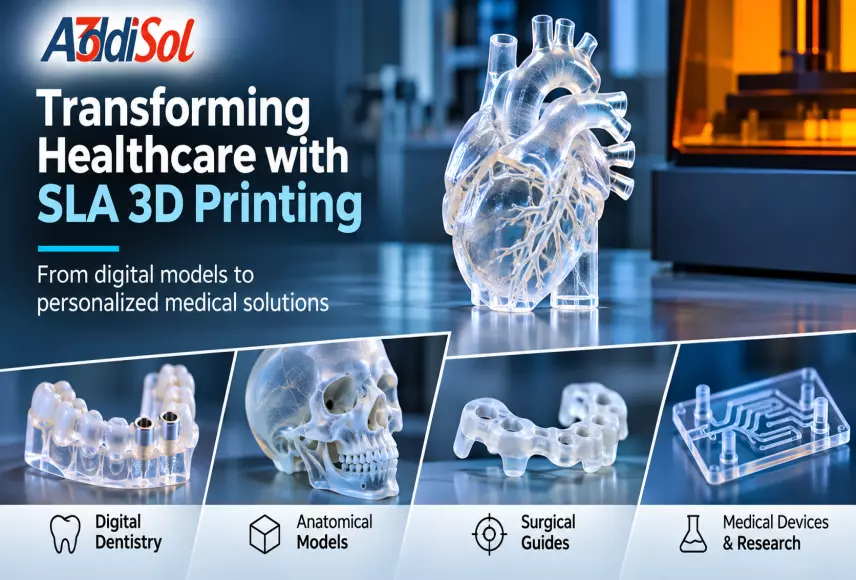
Additive manufacturing is transforming the healthcare industry by introducing new possibilities for personalized treatment, surgical planning, medical device development and clinical education.
Among the various 3D printing technologies, Stereolithography (SLA) stands out for its high dimensional accuracy, fine feature resolution, excellent surface finish and expanding range of specialized materials.
From patient-specific anatomical models to customized dental appliances, SLA technology is helping healthcare professionals bridge the gap between digital medical data and physical medical solutions.
Stereolithography is a vat photopolymerization technology that uses a controlled light source, typically a laser, to selectively cure liquid photopolymer resin, building three-dimensional objects layer by layer.
Its key advantages include:
High dimensional accuracy and repeatability.
Excellent surface quality.
Ability to reproduce complex anatomical geometries.
Fine feature resolution.
Availability of specialized and biocompatible resins.
Rapid production of customized components.
Reduced dependence on conventional tooling.
These capabilities make SLA particularly attractive for medical applications where precision and customization are essential.
Medical imaging data obtained from CT and MRI scans can be converted into three-dimensional digital models and subsequently manufactured using SLA printers.
These models can help medical professionals visualize complex anatomical structures, including bones, organs, vascular systems and craniofacial geometries.
Potential benefits include:
Improved preoperative planning.
Better understanding of complex anatomical conditions.
Enhanced communication between surgeons and patients.
Simulation and evaluation of proposed surgical approaches.
Improved multidisciplinary collaboration.
SLA technology enables the production of patient-specific surgical guides designed around individual anatomical characteristics.
Applications include orthopedic surgery, maxillofacial surgery, dental implantology and reconstructive procedures.
When appropriately designed, manufactured and clinically validated, these guides can support greater procedural precision and consistency.
Dentistry represents one of the most established applications of resin-based additive manufacturing.
SLA printers can be used to manufacture:
Dental models.
Implant surgical guides.
Orthodontic models.
Denture bases.
Temporary crowns and bridges.
Occlusal splints.
Casting patterns.
Models for thermoforming clear aligners.
Digital dentistry allows dental laboratories and clinics to establish integrated workflows connecting intraoral scanning, computer-aided design and additive manufacturing.
SLA printing can support the development of customized prosthetic and orthotic solutions through anatomical models, fitting prototypes, molds, casting patterns and selected functional components.
The ability to manufacture complex geometries enables engineers and healthcare professionals to explore solutions tailored to individual patient requirements.
SLA technology provides biomedical engineers and medical device manufacturers with a powerful platform for rapid prototyping and product development.
Potential applications include:
Medical device housings.
Diagnostic equipment components.
Microfluidic devices.
Laboratory accessories.
Customized medical instruments.
Functional prototypes.
Rapid design iterations can reduce development time, facilitate design validation and accelerate innovation.
Traditional anatomical teaching resources may not always adequately represent the complexity and variability of human anatomy.
SLA printing enables educational institutions to create detailed anatomical models representing specific medical conditions and anatomical variations.
These models can support medical education, surgical training, clinical simulation and biomedical engineering education.
A typical medical additive manufacturing workflow involves several interconnected stages:
Acquisition of medical imaging data.
Image segmentation and anatomical reconstruction.
Three-dimensional modeling and design optimization.
Selection of appropriate printing materials.
SLA additive manufacturing.
Post-processing and quality inspection.
Application-specific validation.
The integration of medical imaging, engineering design and additive manufacturing creates opportunities for closer collaboration between healthcare professionals and engineers.
Not all SLA resins are suitable for medical applications.
Material selection must consider the intended application, mechanical properties, chemical resistance, biocompatibility, sterilization compatibility and regulatory requirements.
For applications involving patient contact, the entire manufacturing workflow—including printing, washing, post-curing and any required sterilization—must be appropriately validated.
A biocompatible resin alone does not automatically guarantee that the finished printed component is suitable for clinical use.
As photopolymer materials, digital imaging technologies and additive manufacturing systems continue to advance, SLA printing is expected to play an increasingly important role in healthcare innovation.
Emerging opportunities include:
Point-of-care manufacturing within hospitals.
Personalized medical devices.
Advanced surgical simulation.
Customized rehabilitation solutions.
Microfluidic diagnostic platforms.
AI-assisted anatomical reconstruction and medical design.
The future of medical additive manufacturing will depend not only on advances in printing technology but also on the successful integration of engineering expertise, clinical knowledge, material science and regulatory compliance.
At AddiSol, we believe that additive manufacturing represents more than a manufacturing technology. It is an enabling platform for innovation across multiple industries, including healthcare.
By bringing together advanced manufacturing technologies, engineering expertise and digital design capabilities, we aim to support healthcare institutions, universities, research centers and industry partners in exploring the full potential of additive manufacturing.
The future of healthcare is increasingly personalized, digital and engineering-driven. SLA 3D printing is one of the technologies helping make that future possible.
Discover more at: https://additive-solutions.net

AddiSol and WTech are proud to announce a strategic partnership that brings together advanced 3D printing innovation and world-class structural engineering.